
What is GenAIoT®?
A citeable, practitioner-grade definition of GenAIoT — and the core concepts needed to deploy it safely and economically across IoT + Edge environments.
Powered by IoT Community® • Built with practitioners and founding partners
A canonical definition
GenAIoT® (Generative AI + IoT) is the application of generative AI to IoT and edge systems where real-world context, constraints, and accountability matter.
It combines telemetry, events, asset models, digital twins, and operational knowledge with generative reasoning to produce insights, recommendations, and bounded actions — with governance, observability, and measurable outcomes built in.
In plain English: GenAIoT turns connected data into decisions — and decisions into action — safely, at scale.
Key principle: In GenAIoT, the “model” is not the system. The system is model + context + tools + controls.
Why GenAIoT is happening now
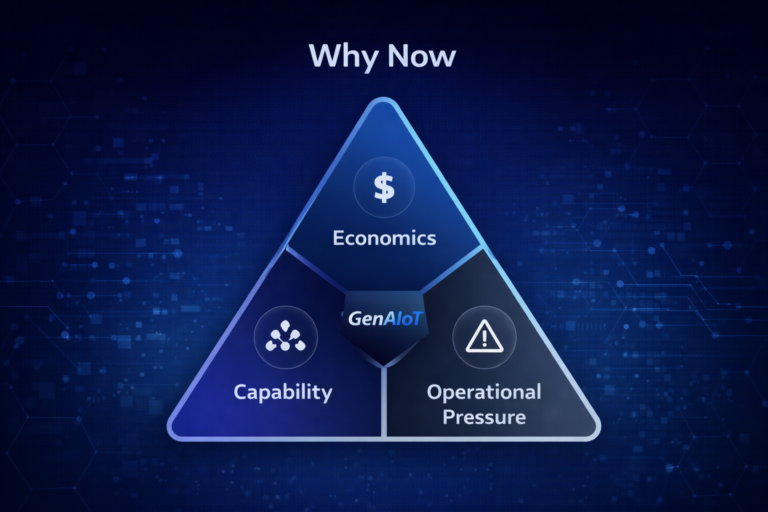
Three forces have converged:
1. Economics moved
Model inference costs are dropping, smaller models have improved dramatically, and hybrid patterns (edge + cloud)
make it practical to deploy intelligence where latency and privacy matter.
2. Capability crossed a threshold
Modern foundation models can synthesize across sources, call tools, explain reasoning, and handle natural language interfaces —
but only reliably when grounded in strong context and retrieval.
3. Operational pressure is rising
IoT environments are high-variance, always-on, and resource constrained. Teams are expected to reduce downtime,
improve efficiency, and operate safely under tighter staffing and higher complexity. GenAIoT responds to that gap:
faster decisions without sacrificing control.
What’s new vs “AIoT”
AIoT has typically meant applying ML to IoT data for prediction, detection, and optimization.
GenAIoT keeps those strengths — and adds four step-changes:
Context fusion at scale
Tool use + orchestration
Natural language as an operating interface
Bounded autonomy
Core concepts that make GenAIoT work
Retrieval-Augmented Generation (RAG)
Grounds model responses in operational knowledge (docs, tickets, policies) and IoT context (events, asset data). RAG reduces hallucination risk and improves explainability via citations/provenance.
Agents & tool calling
Agentic patterns allow models to call tools (search, diagnostics, scheduling, configuration, ticketing) and execute multi-step workflows — while staying inside guardrails (policy checks, approvals).
Digital twins & asset models
A twin or asset model provides structure: identity, relationships, topology, constraints, and state. It’s the difference between “data” and “context.”
Time-series context
IoT is temporal. GenAIoT needs time-aware retrieval: windows, seasonality, baselines, anomalies, change points, and event correlation — not just document search.
Model routing
Different tasks need different models. Routing selects models based on latency, cost, privacy, reliability needs, and task type (classification vs summarization vs planning).
Controls & observability
Production GenAIoT requires policy gates, evaluation, tracing, and audit logs — so actions remain bounded, accountable, and measurable over time.
What GenAIoT is / isn’t
What GenAIoT is
- A systems approach: model + context + tools + controls.
- An operating model for human-in-the-loop automation.
- A way to deploy GenAI in environments that demand safety, auditability, and measurable outcomes.
- A bridge between IoT signals and enterprise action (tickets, work orders, configurations, dispatch, reporting).
What GenAIoT isn’t
- A chatbot glued to dashboards.
- “Fully autonomous control” without governance.
- Cloud-only inference by default (edge constraints matter).
- A model-first project that ignores data quality, topology, and operational reality.
- A replacement for deterministic controls in safety-critical systems.
Outcomes GenAIoT targets
(and how to measure them)
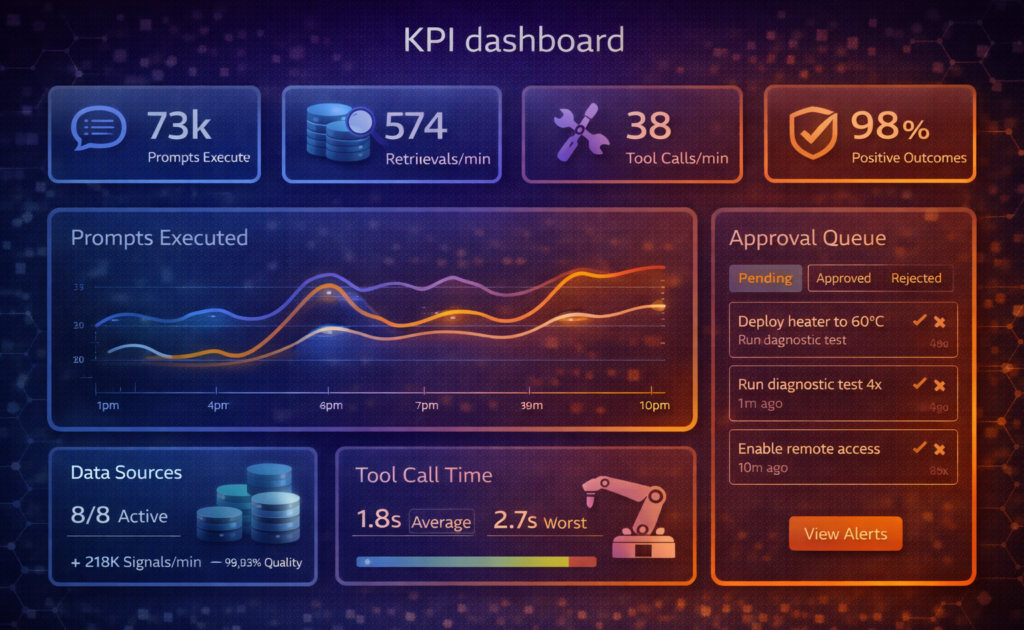
GenAIoT is only “real” if outcomes move. Common KPI targets include:
Reliability & maintenance
- Reduced unplanned downtime
- Lower MTTR (mean time to repair)
- Higher first-time fix rate
- Fewer repeat incidents
Quality & throughput
- Improved yield / reduced scrap and rework
- Faster root-cause analysis
- Increased OEE (where applicable)
Energy & sustainability
- Reduced energy per unit output
- Peak load reduction / better demand response
- Lower emissions intensity (where measured)
Field operations
- Fewer truck rolls
- Shorter dispatch-to-resolution time
- Better parts utilization / fewer wasted visits
Safety & risk
- Fewer safety incidents and near misses
- Higher compliance adherence (audit readiness)
- Reduced cyber/operational risk exposure (where measured)
Customer experience
- Improved NPS / CSAT
- Faster issue resolution and more transparent communications

GenAIoT Glossary
| Term | Definition |
|---|---|
| Agent | A system that plans and executes multi-step tasks by calling tools and using context, often with guardrails and approvals. |
| Audit Trail | A tamper-resistant record of what was recommended or done, by whom or what, when it occurred, and which inputs were used. |
| Context Layer | The structured representation of operational reality, including assets, topology, state, constraints, and policies. |
| Digital Twin | A model of an asset or system that captures identity, relationships, constraints, and state over time. |
| Edge Inference | Running model inference close to devices to meet latency, privacy, resilience, or cost requirements. |
| Evaluation (Evals) | Tests that measure model or system behavior, such as accuracy, safety, and reliability, across expected scenarios. |
| Feature Store | A managed repository for machine learning features used consistently in both training and inference. |
| Hallucination | Model-generated content that appears plausible but is unsupported or incorrect; mitigated through retrieval, constraints, and evaluations. |
| Human-in-the-Loop (HITL) | Approval or review steps that keep humans accountable for specific decisions or actions. |
| Model Routing | Selecting the appropriate model (by size, location, or provider) based on latency, cost, privacy, and reliability needs. |
| Observability | Instrumentation for tracing, metrics, logs, and monitoring across prompts, tools, actions, and outcomes. |
| Policy Engine | Rules and constraints that determine which actions are allowed, under what conditions, and with which approvals. |
| Provenance | Traceability of outputs back to the specific data sources, documents, and events used to generate them. |
| RAG (Retrieval-Augmented Generation) | Retrieval of relevant knowledge or context to ground model outputs and reduce hallucinations. |
| Safety Envelope | Defined boundaries of autonomy, including permitted actions, thresholds, approvals, and rollback conditions. |
| Semantic Layer | A shared vocabulary or ontology that standardizes meaning across systems and data sources. |
| Time-Series Database | A database optimized for storing and querying time-stamped telemetry and high-frequency signals. |
| Tool Calling | Model-initiated invocation of external functions or APIs such as search, diagnostics, ticketing, or scheduling. |
| Vector Database | A database that stores embeddings for similarity search, commonly used for semantic retrieval in RAG systems. |