The architecture, in one line
In GenAIoT, the “model” is not the system. The system is model + context + tools + controls.
GenAIoT systems connect real-world signals to real-world outcomes — safely — by combining edge and cloud intelligence with a context layer, retrieval, governed tool use, and end-to-end observability.
The architecture, in one line
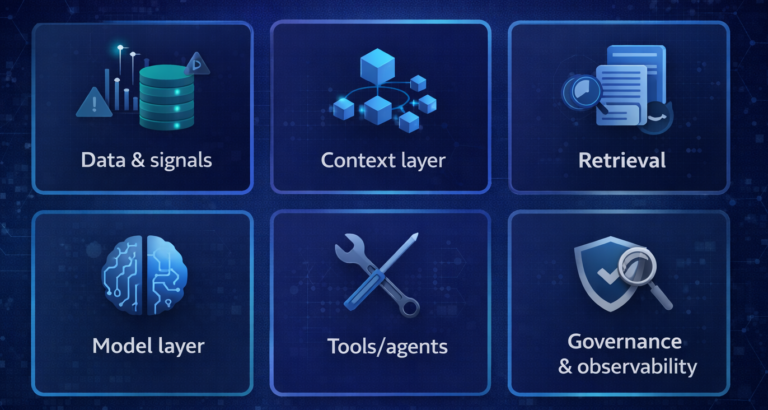
The 6 MVP building blocks
01.
Data & signals
This is the system’s “ground truth” — high-volume, high-variance inputs such as:
- Telemetry and events (time-series, logs, alarms)
- Video and audio streams (where applicable)
- Location, environment, and network state
- Enterprise operational signals (tickets, work orders, parts, schedules)
02.
Context layer
Context turns data into meaning. This layer provides structure and constraints, such as:
- Asset models (identity, hierarchy, relationships, topology)
- Digital twins (state + constraints over time)
- Semantics/ontology (consistent vocabulary across systems)
- Feature store and derived signals (shared, reusable inputs)
03.
Retrieval (time-series + knowledge)
GenAIoT relies on retrieval to ground outputs and reduce hallucinations:
- Time-series retrieval: baselines, historical windows, similar incidents, correlated signals
- Document retrieval: manuals, SOPs, tickets, runbooks, safety policies, vendor notes
- Hybrid retrieval: merge telemetry context with text sources and rank by relevance/recency
04.
Model layer (routing + deployment posture)
Different tasks require different models and placements:
- Routing: select models by latency, cost, privacy, and reliability targets
- On-device vs cloud: edge inference for low latency/resilience; cloud for heavy reasoning
- Small vs large models: smaller models for classification/extraction; larger for synthesis/planning
- Guarded generation: constrained outputs, deterministic checks, and evaluation gates
05.
Tools/agents (execution and orchestration)
This is where GenAIoT moves from insight to operational impact:
- Diagnostics and guided troubleshooting
- Work order creation and triage (ITSM / CMMS)
- Scheduling, dispatch, parts checks, escalation workflows
- Safe configuration changes (where permitted)
- Integrations with ERP/CMMS/SCADA/field apps
06.
Governance & observability
This is what makes GenAIoT deployable at scale:
- Evals & testing: golden sets, scenario tests, regression, red-teaming
- Audit logs: who/what/when/why + source citations + tool calls + outcomes
- Safety envelopes: allowed actions, thresholds, approvals, rollback conditions
- Prompt/tool governance: prompt registry, tool permissions (RBAC/ABAC), rate limits
- Monitoring: drift, hallucination indicators, failure modes, cost, latency, reliability
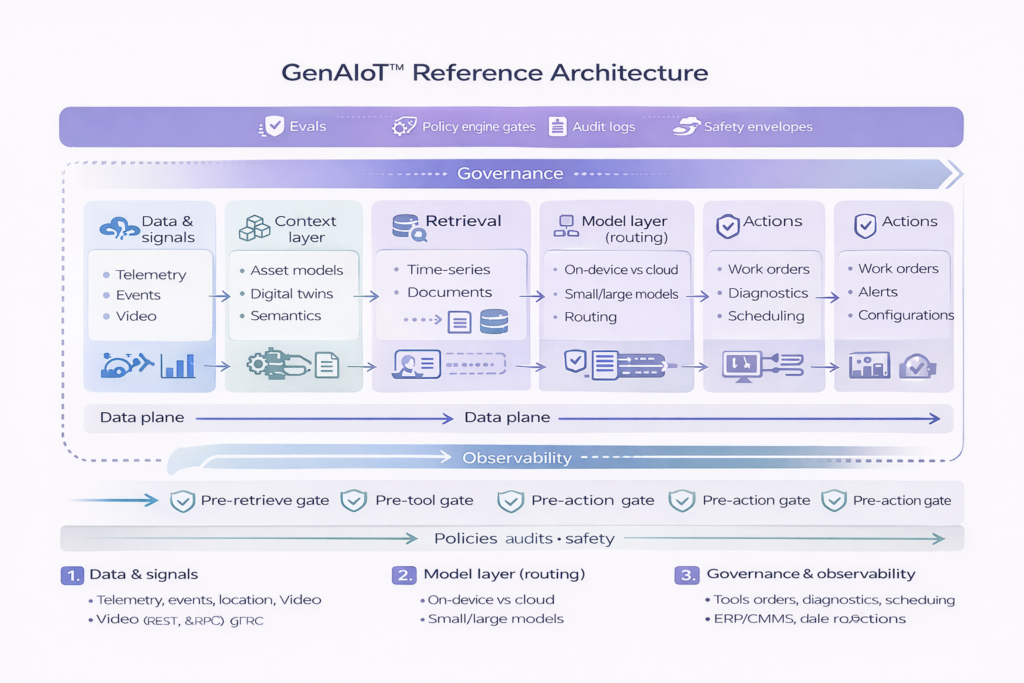
Data plane vs Control plane
Data plane
Signals + context + retrieval that feed reasoning and recommendations.
Control plane
Policies + approvals + audits + evals that constrain and validate actions.
Most failures happen when teams build the data plane first and attempt to “bolt on” governance later.
Deployment patterns (MVP list)
Pattern A: RAG Copilot for Operations
Use when: you need faster troubleshooting and higher-quality decisions.
Inputs: telemetry + tickets + manuals
Output: grounded explanations + recommended next steps with citations
Pattern B: Guided Automation (Human-in-the-loop)
Use when: actions impact reliability, safety, or cost.
Tools: work orders, scheduling, diagnostics
Controls: approvals + policy gates + rollback
Pattern C: Edge-first Intelligence
Use when: latency, privacy, or resilience dominates.
Edge: local inference + local context
Cloud: periodic learning, heavier analysis, fleet-wide insights
Quick checklist for teams adopting the reference architecture
- Do we have an asset model or twin to anchor “context”?
- Can we retrieve both time-series history and operational documents?
- Do we route models by task/latency/cost rather than “one model everywhere”?
- Are tool calls gated by policy and approvals with rollback?
- Do we log provenance and outcomes end-to-end?
- Do we have evals that reflect real operating scenarios?